
On starting over at 50, building a luxury skincare brand from my kitchen, and the economics of delayed gratification.
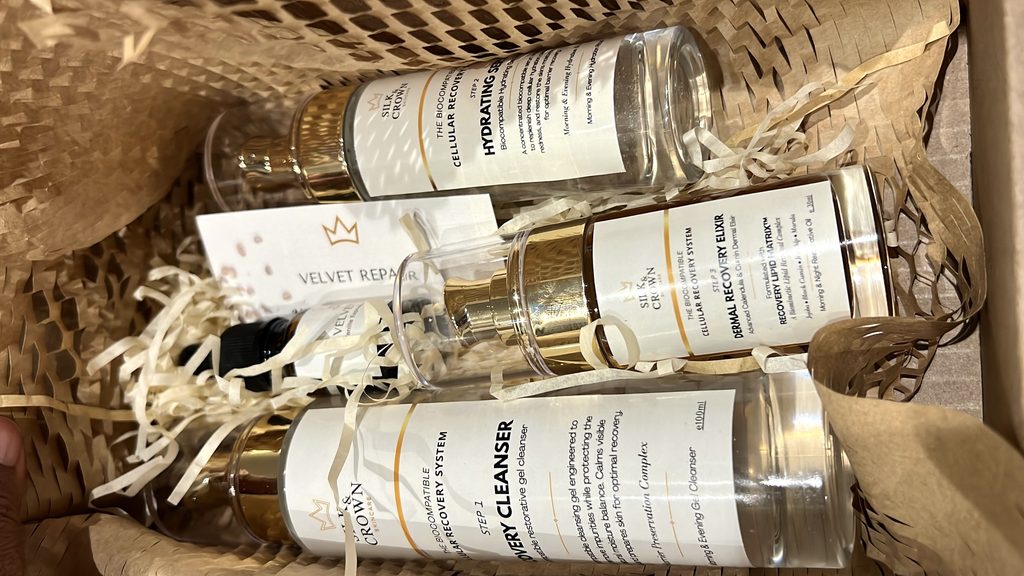
There are days when, by the time I finish making skincare, my body knows I have been at work long before my bank account does.
Formulating skincare from scratch is incredibly labour intensive, and I don’t think that is something that necessarily translates through the beautiful little videos we put online. There is so much standing involved, so much moving backwards and forwards, lifting, washing, sterilising, measuring, heating, mixing, pouring, bottling and labelling. By the end of some production days, sitting down doesn’t even feel like rest so much as my body finally informing me that we are finished now.
Except, of course, we’re not finished. 😂
Because after making the products, there is still a company to run. There are customers to answer, orders to process, stock to check, suppliers to deal with, content to create and a website that apparently requires feeding like another child. There is always something I need to source, something I am researching or, as is increasingly the case with me, something I made perfectly well three weeks ago that I have now decided could be better.
This is the part of building SILK & CROWN that the photographs don’t particularly explain.
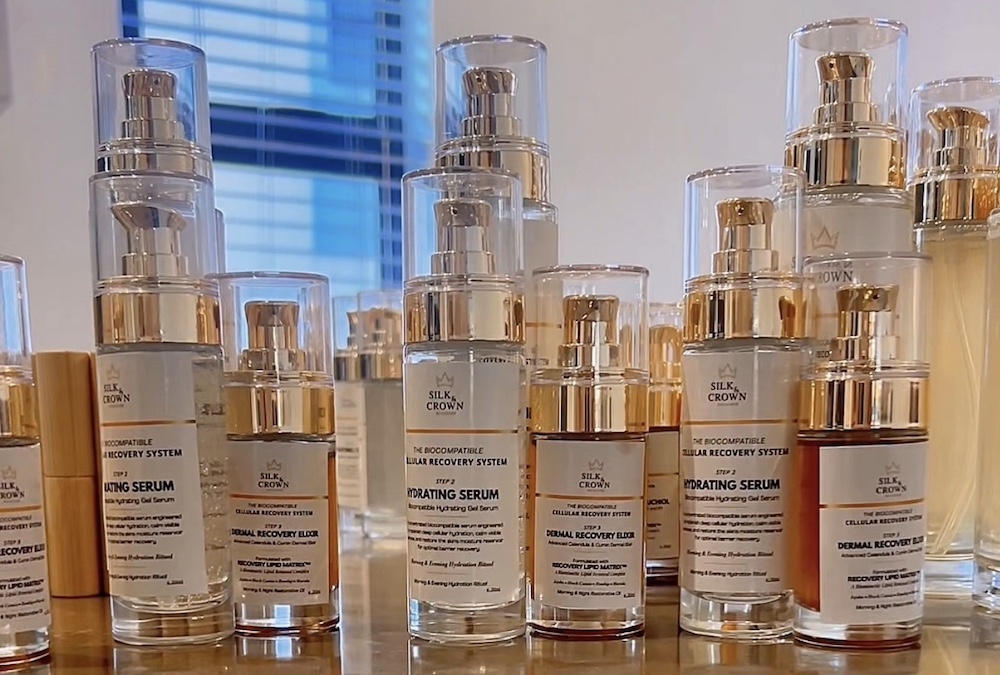
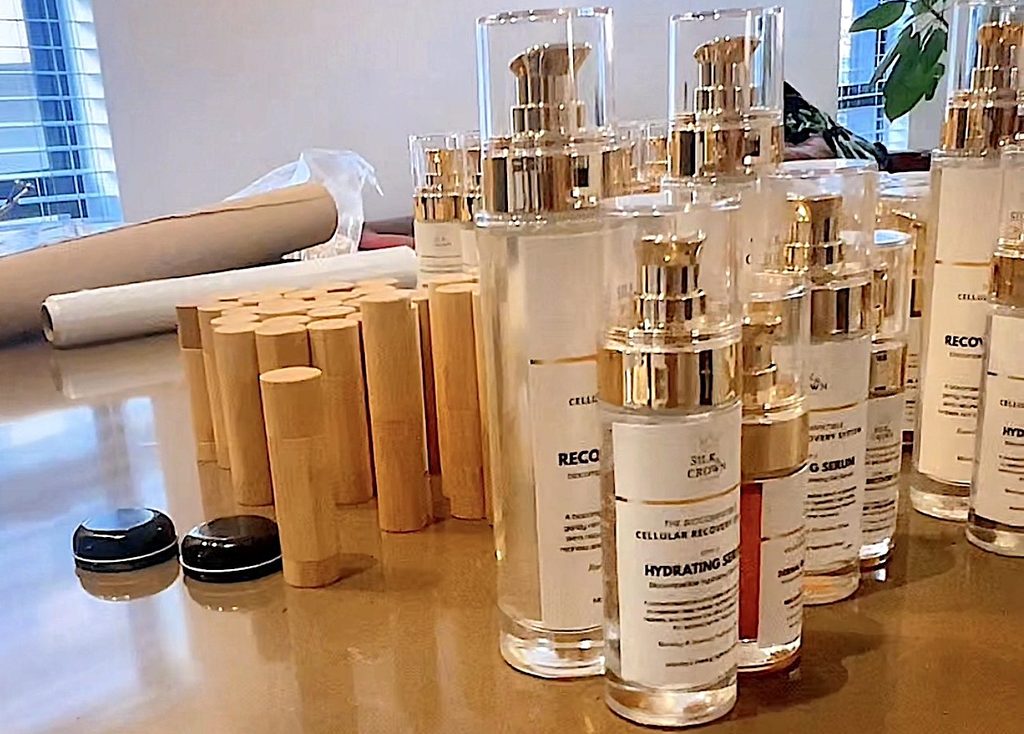
You see the beautiful bottles lined up on the table, the gold pumps, amber glass, creamy body butters and oils slowly infusing with botanicals, and I love that part of it too. I take enormous pleasure in seeing the finished products together because I know what went into creating them. But behind that serene-looking table is a woman who has probably been on her feet for hours and who, at this stage of the business, also happens to be every department in the company.
You may have created yourself a job that doesn’t pay you yet
I think this is something we don’t say enough when we encourage people to start businesses, particularly now when entrepreneurship is presented as one of the answers to needing another source of income.
In the beginning, you may not actually have a business that pays you. You may have created yourself an extraordinarily demanding job that doesn’t pay you yet, and I think understanding the difference between those two things is important if you’re going to survive the early stages without becoming completely disillusioned.
I can see SILK & CROWN growing. I can see customers returning, people beginning to know products by name and a reputation gradually forming around what I make and the philosophy behind why I make it. Those things tell me that there is movement, and I find that incredibly encouraging.
But growth doesn’t mean that every rand coming through the door has suddenly become mine to spend.
In fact, at this stage, almost every rand that comes into the business has somewhere else it could very sensibly go. There are ingredients to replenish, packaging to improve, equipment that would make production more efficient, formulations I want to refine and new things I want to test. Sometimes something works beautifully, but making it teaches me enough to realise that there is an even better version of it available to me if I’m prepared to invest in getting there.
And because I am building this myself, those decisions sometimes sit directly opposite my own immediate comfort.
The economics of my stomach
I used a phrase recently that probably sounds more dramatic than I intended it to:
Formulating skincare from scratch cannot be dictated by the economics of my stomach.
What I mean is actually quite simple.
I cannot treat every rand that enters SILK & CROWN as evidence that I can now afford to take that money out of the business. There are times when I would personally like or even feel I could really use something, but I know that the business needs the money more urgently. That doesn’t mean I believe suffering is noble or that entrepreneurs should deprive themselves of basic needs in order to prove how committed they are. I don’t.
I’m talking about delayed gratification, and perhaps more specifically, understanding that the money generated by a young business often needs to build the infrastructure of that business before it can meaningfully improve the lifestyle of the person who owns it.
That is a difficult thing, particularly when you are starting a business partly because you want another source of income.
The money can be sitting right there, and you still have to understand that it has already been spoken for. It belongs to the next batch, the raw materials, the packaging, the equipment or the mistake you have to correct. Sometimes it belongs to improving something that customers already like simply because you have learned enough to know you can make it better.
And this is where having a longer vision becomes important to me, because if my immediate comfort dictates every decision, I could very easily begin compromising the thing I am trying to build.
Luxury is expensive before anybody calls you luxurious
This has probably been one of the more interesting contradictions of building SILK & CROWN.
Everything is made from my home. My kitchen is my production space. There is nothing particularly glamorous about that sentence. 😂
I don’t have a beautiful laboratory with SILK & CROWN etched into glass doors, nor do I have a production team arriving in the morning while somebody else handles procurement, fulfilment and customer service. Those things may come later, but they are not my present reality.
And yet, I have decided that what I am building is a luxury skincare house.
For me, that creates an important distinction between circumstance and standard.
My present circumstances determine the size of the room available to me, the amount of equipment I can buy at once, how quickly I can expand and how many things I have to do myself. What those circumstances do not have to determine is the standard of what I allow to leave that room.
I cannot yet control the size of the room I am building this in. I can control the standard of what leaves it.
I think that has quietly become one of my strongest principles in building SILK & CROWN.
People have described the brand in ways that have been very interesting for me to hear from the outside: natural, organic in its aesthetic, intentional, even conservation-minded. There is clearly something people are recognising about our desire to maintain and support what is natural, both in how I think about skin and in how I think about our relationship with the environment.
But a reputation like that cannot simply be designed onto a beautiful label.
It has to be earned through hundreds of small decisions that customers may never know were made. It happens when I choose an ingredient because I genuinely believe it belongs in the formulation rather than because it allows me the largest margin. It happens when I revisit something that is already good because I’ve learned something new, or when I spend money improving the product instead of immediately extracting that money from the business.
And perhaps most importantly, it happens in the shortcuts I choose not to take even when nobody would ever have known that I took them.
That, increasingly, is what luxury means to me. Of course presentation matters. Packaging matters. The experience matters. But beneath all of those things has to be a standard that exists even when nobody is looking, otherwise we’re really only decorating things beautifully and calling them luxury.
What the finished bottle doesn’t tell you
Social media makes all of this slightly peculiar because we tend to meet businesses at the visually interesting part of the story. We see launches and beautiful packaging, orders stacked on tables, courier collections, new premises and eventually the founder standing next to something that looks, in retrospect, almost inevitable.
What is much harder to photograph is the long stretch during which none of it feels inevitable.
There are the batches you have to make again, packaging choices that seemed brilliant until you actually had to live with them, supplier problems, your own mistakes and the hours spent learning things you didn’t even know you needed to know. There is also the strange experience of working at the standard of the business you hope to have one day while still living within the economics of the business you actually have today.
I think those two realities have to coexist for quite a long time.
Perhaps that is also why I am cautious when people ask me how I do this, particularly when the conversation is coming from someone who is considering starting something of their own. There are many practical things I can explain. Formulation can be learned. Branding can be learned. You can learn websites, packaging, photography, marketing, social media and selling, and you will probably become reasonably competent at several things you had absolutely no intention of learning when you started.
What I don’t know that anybody can teach you is the willingness to remain with something through the period when the amount of effort and the amount of financial reward bear almost no resemblance to one another.
That is where I think passion matters, although perhaps not in the romantic way we usually talk about it.
Passion doesn’t prevent you from becoming tired. It doesn’t make financial discomfort comfortable, and it certainly doesn’t guarantee that the thing you are building will become successful. What it can do is give you a reason to tolerate the uncertainty for longer, because the work itself means enough to you that you are prepared to keep learning, refining and moving while the outcome is still uncertain.
Passion doesn’t make the work easier. It gives the difficulty somewhere to belong.
Starting again at 50
And then there is the small matter of doing all of this at 50.
There is something quite peculiar about reaching an age when society generally assumes you should have arrived somewhere and then voluntarily putting yourself back into the vulnerable position of being a beginner.
By 50, we’re supposed to know what we’re doing. We are supposed to be established and, preferably, comfortable.
Instead, I find myself standing in my kitchen learning things I didn’t know six months ago, getting things wrong, changing my mind, trying again and building something whose eventual shape I can see much more clearly in my imagination than I can in my present circumstances.
But I don’t actually think I started SILK & CROWN from nothing.
I started it with 50 years behind me.
And there is a difference.
I came into this with the benefit of having lived enough life to know myself better. I have made enough mistakes to recognise some of them sooner, developed enough taste to understand when something doesn’t feel right to me, and acquired enough discernment to be much more careful about what I am willing to attach my name to.
There are absolutely things I might have had at 30 that would have made starting a business easier. I probably had considerably more tolerance for standing on my feet all day, for one. 😂
But there are things I have at 50 that I could not have bought at 30, and discernment is one of them.
So I would rather build slowly with discernment than quickly without it.
Building the platform
I don’t know exactly what SILK & CROWN will look like five years from now, although I certainly have a vision for it.
I hope there will come a time when production no longer happens in my kitchen and when there are other people working alongside me, with proper infrastructure around work that currently depends overwhelmingly on my own two hands. And yes, I absolutely hope the business eventually pays me very well.
I don’t think there is any virtue in pretending financial success isn’t part of why we build businesses.
I want the comfort and freedom that can come with having built something successful. I would love the beautiful production space, the team and the ability to look at an ingredient I believe belongs in a formulation and make that decision primarily because it is right for the product, rather than having to consider whether this month’s cash flow can accommodate it.
I want all of those things.
I simply understand that I am not there yet.
What I am doing now is creating the platform that might make those things possible later, and that means there will still be long days on my feet and money that arrives only to immediately acquire another purpose. There will be personal comforts I postpone, things I cannot afford to do yet and probably many more evenings when I look at a table filled with beautiful bottles and think, with enormous satisfaction, these look absolutely gorgeous — while simultaneously thinking, Good Lord, my back hurts. 😂
But when I look at where SILK & CROWN was and where it is now, I can see it moving.
Sometimes slowly, and occasionally much more slowly than I would like, but it is moving forward.
For this season, that is enough for me.
I know what I am building, and I understand what this stage of building requires from me.
The money must build the business before the business can build my life.